AI customer health scoring · customer health score automation · SaaS health scoring
AI Customer Health Scoring: How SaaS Teams Spot Churn Risk Early Without Trusting a Black Box
V12 Labs··10 min read
Short answer
AI customer health scoring helps SaaS teams turn messy account signals into usable risk explanations, owner-ready briefs, and earlier retention action.
Most health scores fail for a simple reason:
they produce a color, not a decision.
An account turns yellow or red. A dashboard updates. A CSM sees the change. Then the real work still starts manually: figure out what changed, check support history, inspect onboarding status, read the last call notes, review product usage, and decide whether this is noise or a real retention problem.
That is why many teams do not really need a better dashboard first.
They need a better operating system for account risk.
That is the practical value of AI customer health scoring.
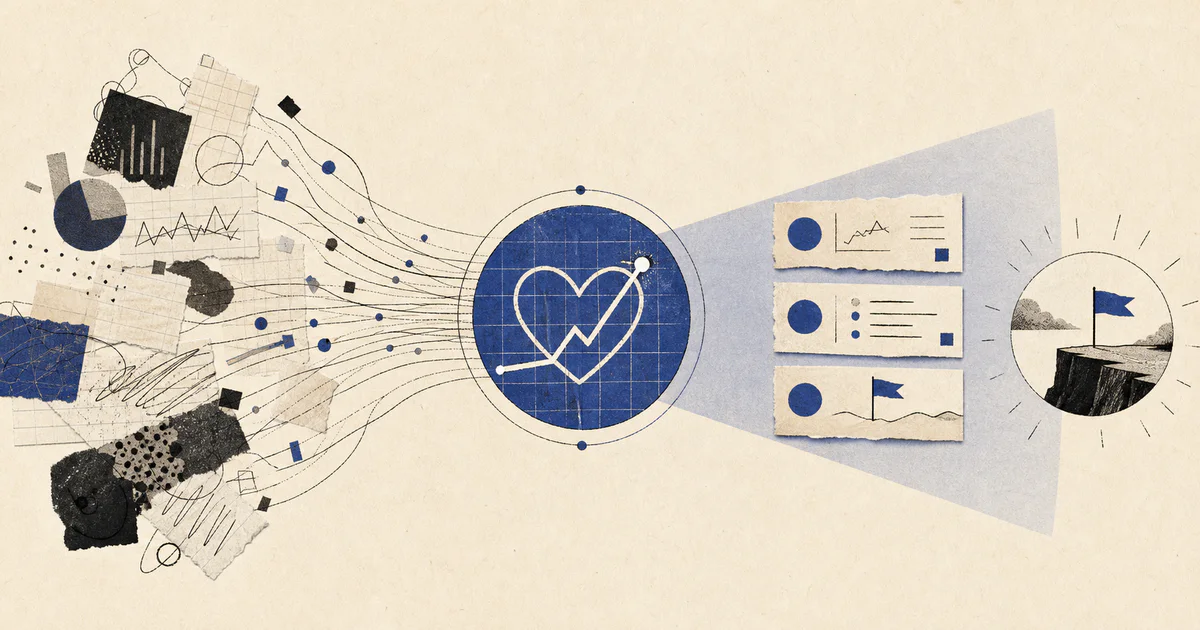
Instead of treating health as one static formula, an AI workflow can combine messy signals, explain why an account looks healthy or risky, and prepare the next action for the person who owns the relationship.
If your retention work already starts closer to the contract date, read AI renewal automation. If your bigger problem is broad lifecycle coordination, start with AI customer success automation. Health scoring sits upstream of both.
If you would rather have V12 Labs build it, get your free agent plan. We will put the scope, timeline, and price range in writing. You keep the plan, and if we build it, you own the code, data, and IP from day one.
AI customer health scoring is the use of AI inside customer-success operations to evaluate account condition using multiple signals, then turn that evaluation into structured workflow output.
That usually includes:
a current health assessment
the reasons behind the score
the signals that changed recently
the likely business risk
the recommended next action
the owner who should act
That is different from a traditional health score field in the CRM.
A normal score often depends on a handful of static weights:
product usage
NPS
number of tickets
renewal date proximity
CSM sentiment
Those inputs can be useful. The problem is that they are often too shallow, too delayed, or too hard to interpret in isolation.
AI helps because it can synthesize messy context across tools, not just calculate a number from clean fields.
Why most customer health scores break down in practice
The issue is usually not that teams forgot to define a score.
It is that the score rarely reflects how risk actually appears inside a live account.
Real account deterioration is usually mixed and gradual:
product usage falls for one team but not another
an implementation blocker is still unresolved
support tickets are not high in volume, but they are severe
a champion has gone quiet
executive stakeholders stopped joining calls
proof of value is weak even though activity still looks decent
A static formula can miss those patterns or flatten them into an unhelpful average.
This is why customer health score automation should not just mean "calculate faster."
It should mean:
gather the right signals automatically
interpret them in context
explain what matters
push the right action into the workflow
Want an agent doing this for you?
We build custom AI agents and the software around them, shipped in weeks. You own the code, and we stay for support.
If support pain is rising, the account may be less healthy even before usage collapses.
3. Onboarding and implementation signals
Many "churn surprises" are not surprises.
They are onboarding problems that stayed invisible too long.
Important onboarding inputs include:
go-live status
incomplete integration steps
delayed implementation milestones
unresolved customer dependencies
time-to-value slippage
This is why AI customer onboarding systems matter so much to retention. If onboarding never stabilized, the health score should not pretend the account is healthy because one stakeholder logs in regularly.
4. Commercial and relationship signals
Account health is not only a product metric.
It is also a relationship and revenue metric.
Useful signals here may include:
renewal timing
stakeholder responsiveness
champion change or turnover
expansion interest
contract tier
recent pricing friction
survey or meeting sentiment
This is where health scoring becomes operationally valuable for renewals, forecasts, and account prioritization instead of staying trapped in a CS dashboard.
What AI adds beyond a normal health score
The real advantage is not magical prediction.
It is better explanation and better workflow output.
A good AI health-scoring workflow can:
summarize what changed since the last review
explain the top reasons an account moved from green to yellow
distinguish product risk from relationship risk
surface missing evidence instead of pretending confidence
draft an account brief for the CSM or account owner
recommend the next internal step
That makes the output easier to trust.
Teams do not want another opaque score.
They want a system that says:
health is declining because activation dropped 24 percent, two critical tickets remain open, and the original champion has not joined the last three meetings
confidence is moderate because product telemetry is strong, but recent renewal notes are missing
recommended next action is an adoption review plus support escalation before the next executive check-in
That is much more useful than "health score: 63."
What a production AI health scoring workflow looks like
For most SaaS teams, the first useful version is not complicated.
It is disciplined.
A trigger runs daily or weekly for active accounts.
The workflow gathers account context from CRM, product analytics, support tools, onboarding records, and recent notes.
Business rules decide which signals matter by segment, stage, or contract type.
AI evaluates the account using bounded prompts or structured classification tasks.
The system produces a health assessment with reasons, confidence, and recommended action.
Risky or ambiguous accounts are routed to the right owner with a brief.
Outcomes are tracked so the team can improve the scoring logic over time.
That is the same pattern we use for a broader AI workflow system: grounded inputs, narrow tasks, visible reasoning, and clear human ownership.
A practical example
Imagine a mid-market SaaS company with 600 customers and a lean customer success team.
Every Monday, the workflow reviews accounts above a certain ARR threshold plus any account renewing in the next 120 days.
For each account, it pulls:
product usage trend by workspace
open support issues and escalation status
onboarding milestone completion
meeting notes from the last 45 days
stakeholder activity and responsiveness
renewal date and contract value
The system then outputs:
current health: healthy, watch, or at risk
top three reasons
what changed since the prior review
missing context that lowers confidence
recommended owner action
One account may be flagged because usage is down sharply and onboarding never fully completed.
Another may be flagged because product usage is steady but support severity has increased and the buyer-side champion disappeared.
Those are different problems.
A strong health system should not collapse them into the same generic score without explanation.
What to automate first
Do not start by trying to replace every account review.
Start with the workflows that create leverage quickly.
1. Weekly risk summaries for named accounts
This is often the best first use case.
The system prepares a short summary for strategic accounts or renewal-window accounts, including the top risks and the recommended next step.
That gives the team a usable review queue without forcing them to gather context manually.
2. Score-change explanations
Many teams already have health scores.
What they lack is interpretation.
If you already calculate red, yellow, and green status, add AI to explain:
why the status changed
which evidence matters most
whether the issue looks operational, relational, or product-driven
This is lower-risk than replacing the full scoring system on day one.
3. Churn-risk brief generation
A churn risk scoring workflow becomes much more useful when it produces a short action brief, not just a label.
For example:
risk level
likely causes
supporting evidence
recommended next conversation
internal owners to involve
That helps CSMs, AEs, and leaders respond faster.
Common mistakes in AI customer health scoring
The biggest failures are usually workflow design failures.
Treating health as a model-only problem
If the workflow cannot access clean account context, no model will save it.
Health quality depends on:
reliable source data
clear stage definitions
agreed escalation paths
review ownership
feedback loops
Without those, the output may sound smart while remaining operationally weak.
Using one global definition of health
Different account types fail in different ways.
A new onboarding-stage customer should not be scored the same way as a mature enterprise renewal account.
Segment-specific logic usually works better than one formula for everyone.
Hiding low confidence
Sometimes the right answer is not "at risk."
Sometimes the right answer is:
likely healthy, but support notes are stale
likely at risk, but usage instrumentation is incomplete
unclear because the account has multiple active workspaces with uneven adoption
Visible uncertainty is healthier than false precision.
Letting scores sit in dashboards with no workflow attached
This is the most common failure.
If a health score does not route work, prepare context, or trigger follow-up, it becomes reporting instead of operations.
That is why the workflow matters as much as the scoring logic.
Metrics to track after launch
If you want the system to improve, track outcomes that matter:
percent of at-risk accounts later confirmed by humans
percent of missed-risk accounts discovered outside the workflow
time from risk detection to owner action
renewal outcomes for flagged accounts
override rate by account segment
explanation quality feedback from CSMs and account owners
These metrics tell you whether the workflow is creating earlier action or just generating more labels.
FAQ
Is AI customer health scoring the same as churn prediction?
No. Churn prediction is usually a narrower forecasting task. AI customer health scoring is more operational. It combines risk detection with reasons, context, and next-step recommendations the team can act on.
Should AI replace the existing customer health score?
Not necessarily. Many teams get value by keeping the existing score and adding AI explanation, risk summaries, and action routing around it first.
What tools should feed an AI health scoring workflow?
Most teams start with CRM data, product analytics, support tickets, onboarding records, renewal data, and recent notes or call transcripts.
When is this worth building?
It is usually worth building when account reviews are manual, renewals feel reactive, or important churn signals are spread across too many tools for the team to interpret consistently.
If your team wants to turn account health from a reporting exercise into a production workflow, our AI solutions team builds systems that combine customer signals, explain risk clearly, and route the right next action inside the tools teams already use.