2026-07-18loop engineeringAI agentsagentic AI

Loop Engineering, Explained: What It Is, What's Overhyped, and Where It's Going

V12 Labs10 min read

Short answer

Loop engineering went from an unknown phrase to the AI industry's biggest buzzword in about a week. Here's what it actually means, where the backlash has a point, and where the practice goes from here.

On June 7, 2026, Peter Steinberger, creator of the open-source agent project OpenClaw, posted twelve words that broke the AI half of the internet for a week: "You shouldn't be prompting coding agents anymore. You should be designing loops that prompt your agents."

The post cleared 5 million views in a day. Addy Osmani, a Google engineer, published an essay days later giving the idea a name and an anatomy. Boris Cherny, who leads Claude Code at Anthropic, was quoted summing up his own job change in four words: "I don't prompt Claude anymore." By the end of June, "loop engineering" had a thousand explainer posts, a Hacker News thread with 1,800 comments arguing it was nothing new, and at least one team (Uber) capping employee token spend after blowing through a year's AI budget in four months.

Short answer: loop engineering is designing the system that repeatedly prompts, checks, and re-runs an AI agent instead of you typing every next instruction by hand. It's a real and useful pattern for a narrow set of problems. It is not a new idea, it is not free, and most of what got published about it in June was repackaged automation theory with an urgent name.

This post covers what the term actually means, what's missing from most of the coverage, and where the practice is credibly headed.

If you would rather have V12 Labs build it, get your free build plan. We will put the scope, timeline, and price range in writing. You keep the plan, and if we build it, you own the code, data, and IP from day one.

On this page

What loop engineering actually is

Strip the branding and the mechanism is old: a while loop with an LLM call inside it.

While (task not solved):
  1. Send history + context to the model
  2. Get a response
  3. If it's a tool call: execute it, append the result, go to 1
  4. If it's a final answer: stop

That's the base agent loop, and it's not new. It's a direct descendant of the ReAct pattern (Reason + Act) from Princeton and Google research in 2022, and it's the same architecture Anthropic described in its 2024 "Building Effective Agents" post: an LLM, a set of tools, and a loop.

What changed in June 2026 wasn't the mechanism. It was who was doing the looping and how much infrastructure sat around it. Instead of a developer manually re-prompting an agent after each step, the loop itself became a piece of engineering: something you design once, with defined triggers, guardrails, and stop conditions, and then let run without you in it.

Addy Osmani's essay, the piece that gave the practice its name, broke a well-built loop into five parts:

  • Automations: scheduled or triggered tasks that run without a person kicking them off
  • Worktrees: isolated environments so parallel agent runs don't collide on the same files
  • Skills: codified project knowledge so the agent doesn't relearn context every run
  • Connectors: tool and MCP integrations into existing systems
  • Sub-agents: separating the agent that does the work from the agent that checks it

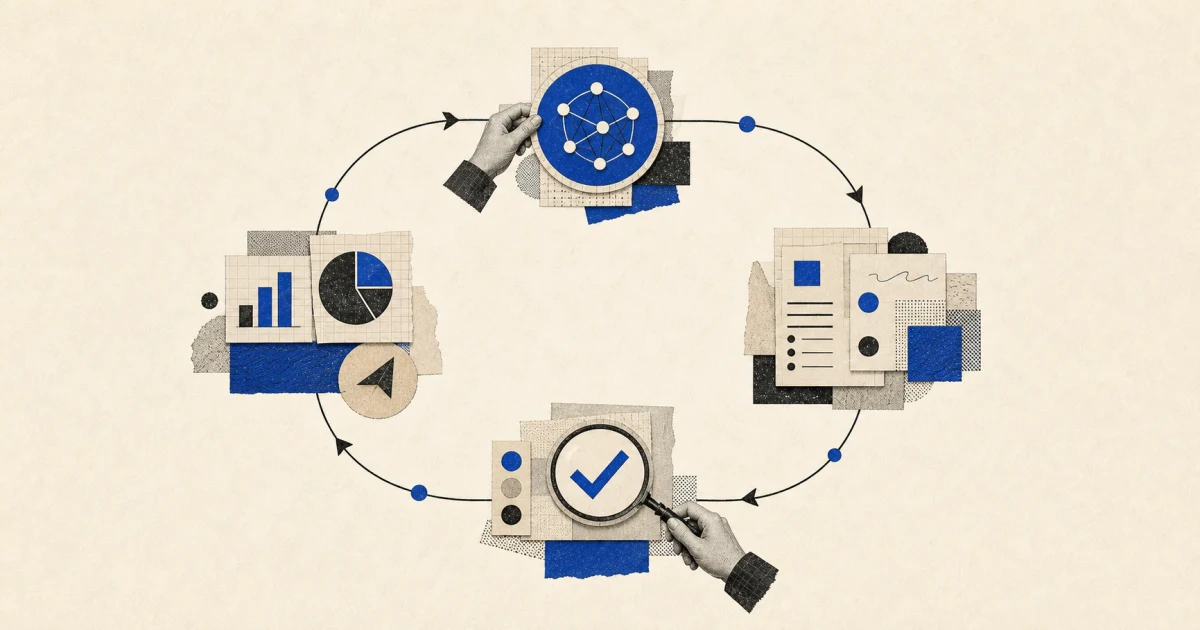
LangChain's "Art of Loop Engineering" post added a second axis worth keeping: loops nest. There's the agent loop (calls tools until done), a verification loop (scores output against a rubric and kicks back failures), an event-driven loop (external triggers fire the whole thing inside a bigger system), and what they call a hill-climbing loop (production traces feed back into improving the agent's own configuration over time). Andrew Ng described something similar as three nested loops running at different speeds: the agent's own coding loop (seconds to minutes), the developer's feedback loop (hours), and the organization's feedback loop (weeks).

The clearest production implementation isn't conceptual, it's a shipped feature: Claude Code, Codex, and other coding agents added /goal-style commands in mid-2026 where you define a completion condition upfront and the agent iterates against it until the condition is met or the budget runs out. That commodified what people like Geoffrey Huntley had been hand-rolling for months with bash scripts (his "Ralph Wiggum" technique: a shell loop that just re-invokes the agent until a task is done).

Where the coverage has real gaps

Most of what got published in the two weeks after Steinberger's post falls into one of two buckets: content-mill explainers restating the same five bullet points, or hot takes that either evangelize the term or dunk on it as repackaged automation. Both miss the more useful middle ground.

Gap 1: nobody quantifies when a loop is worth building. The strongest pushback came from a production operator, not a pundit. A practitioner who runs agent loops daily laid out four conditions that actually determine whether a loop pays for itself: the work has to recur at least weekly, the output has to be machine-verifiable (tests, linters, a build passing) rather than judgment-based, you need a budget that survives failed retries, and the agent needs real tooling (logs, a reproducible environment, execution access). Most people repeating the phrase "loop engineering" this summer aren't running a loop that clears that bar. That's a screening test almost none of the explainer content includes.

Gap 2: the cost story is missing or hand-waved. Agent loops burn roughly 4x the tokens of a normal chat interaction, and multi-agent setups (a maker agent plus a checker agent, which is close to a best practice at this point) push that toward 15x. Uber capped employees at $1,500 a month in token spend after its 2026 AI budget ran out in four months. Almost none of the "what is loop engineering" content mentions a real number, which is a strange omission for a practice whose entire pitch is that it runs unattended and therefore can run a lot.

Gap 3: verification gets a bullet point instead of an architecture. Nearly every writeup lists "verification" as one of five or six equally-weighted components. In practice it's the load-bearing one. Anthropic's own engineering research on long-running agent harnesses treats this as the central problem: an agent grading its own output has a confirmation-bias problem, so production setups need an independent checker agent, an explicit feature list marked failing until proven passing, and end-to-end testing prompts that block an agent from marking something done without actually exercising it. A loop without a verifier that isn't the same model marking its own homework isn't a loop, it's an unattended guess machine.

Gap 4: the "reference-setter vs. regulator" distinction rarely comes up. One of the sharper technical takes on the topic (from a dev.to post cutting through the hype) borrows from control theory: loops are good regulators, they can maintain a target you've already defined, correcting drift and holding a known-good state. They're bad reference-setters, they can't decide what the target should be when a spec is ambiguous or the product decision isn't made yet. Most coverage treats loop engineering as a general substitute for interactive development. It isn't. If you don't know what "done" looks like yet, a loop just automates guessing faster.

Gap 5: the vocabulary mockery is fair, but it's also not the whole story. A widely-shared post mapped the entire lexicon back to plain CS: a while loop became "loop engineering," unit tests became "evals," and so on. That's a legitimate point about hype cycles renaming old ideas. But it undersells the actual shift, which isn't the mechanism, it's that the ecosystem (worktrees, MCP connectors, sub-agent verification, /goal commands) matured enough to make running these loops in production practical for people who aren't building custom infrastructure from scratch. The name is inflated. The tooling underneath it is genuinely new.

Want this built for your business?

We build custom software and AI agents that ship in weeks. You own the code, we stay for support.

Get your free build plan

Free. 30 minutes. You leave with scope, timeline, and a price range.

Where it's actually going next

A few things look more like durable trajectory than hype, based on where the credible technical sources (not the content mills) are pointing:

The vocabulary will fade; the primitives will stay. "Loop engineering" as a phrase has the shelf life of a conference buzzword, it's already drawing the "just a while loop" backlash that eventually kills a term's momentum. But the primitives underneath it (isolated worktrees, skill files, sub-agent verification, event-driven triggers, /goal-style completion conditions) are getting built directly into coding agent products, not just described in blog posts. Those will outlast the name.

Verification becomes a first-class product feature, not a design choice. The maker/checker split (one agent does the work, an independent agent or process checks it) is moving from "best practice someone mentioned" to a built-in mode in agent tooling. Expect coding agents to ship this by default rather than as something a team has to hand-roll, the same way test runners became table stakes rather than optional tooling.

Hill-climbing loops are the next layer up. LangChain's framing, that production traces feed back into automatically improving the agent's own configuration, prompts, or even fine-tuning, is where the more serious engineering orgs are already looking. This is closer to an MLOps feedback loop than a coding assistant feature, and it's the piece most current tooling doesn't do yet.

Cost discipline becomes a forcing function. Uber's budget cap isn't an outlier, it's a preview. As more teams try unattended loops and hit the same token math (4x baseline, up to 15x for multi-agent), expect a wave of tooling aimed specifically at cost-aware loop design: budget-capped agent runs, cheaper models for the checker role, and loops that fail closed (stop and escalate to a human) rather than fail open (keep burning tokens on a stuck task).

The screening question gets standardized. Expect something like the four-conditions checklist (recurring, verifiable, affordable, tooled) to show up as an actual pre-flight check in agent platforms, not just advice in a blog post, because the cost of building a loop for a one-off or ambiguous task is now well-documented enough that vendors have an incentive to warn you before you waste the budget.

The practice underneath the phrase is real. The honest version of it is narrower, more boring, and more expensive than the June hype cycle made it sound, and that's exactly why it'll outlast the name.

The next buzzword is already here

The turnover is already visible. On July 18, 2026, the same Peter Steinberger whose post kicked off the entire loop engineering cycle six weeks earlier asked his followers: "Are we still talking loops or did we shift to graphs yet?" The post cleared 644,800 views within hours.

It's a fair question and it previews the next phrase this whole cycle is likely to produce. A while loop is a flat, single-threaded control structure: one agent, one path, one condition to exit on. A graph is what you reach for once a "loop" actually needs branches, parallel sub-tasks that fan out and merge back, and state that has to be shared across steps that aren't strictly sequential, which is exactly what multi-agent setups with a maker and a checker, or an event-driven system with several triggers feeding one workflow, already are once you draw them honestly. Frameworks like LangGraph have been modeling agent control flow as a graph rather than a loop for a while; Steinberger's post is less a new idea than a signal that the vocabulary is about to catch up to what production systems already look like.

Expect the same cycle to repeat: a viral post renames an existing pattern, a wave of explainer content restates it without added rigor, and a smaller set of practitioners point out the graph framing was already sitting in orchestration libraries before it had a buzzworthy name. The lesson from loop engineering's own six-week arc holds here too: judge the pattern by whether it solves a real coordination problem you have, not by how fast the name is trending.

Where this fits

Get a clear plan before you spend.

V12 Labs will put the scope, timeline, and price range in writing. If we build it, you own the code, data, and IP from day one.

Related reading

Get a build plan