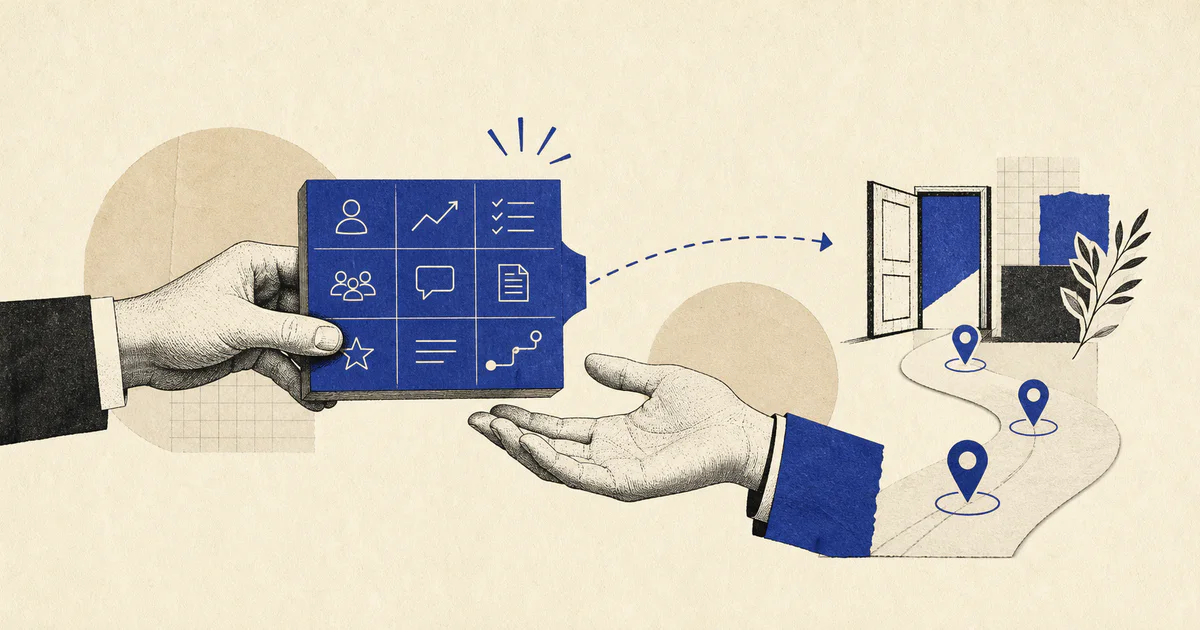
Most post-sale problems do not start during onboarding.
They start one step earlier, at the handoff.
Sales closes the deal. A rep drops a few notes in the CRM. A kickoff call gets scheduled. Customer success learns just enough to get started, but not enough to move confidently. Integration requirements are fuzzy. Success criteria are buried in call recordings. Promised deliverables live in Slack, email, and somebody's memory. The new customer feels the confusion immediately.
That is the real problem AI sales to customer success handoff automation solves.
Short answer: AI sales to customer success handoff automation pulls the deal context, implementation requirements, stakeholders, risks, and promised next steps into one structured handoff so onboarding starts faster and with fewer mistakes.
If your broader issue is the entire revenue engine, start with AI revenue operations automation. If the main breakdown happens after kickoff, read AI customer onboarding systems. The handoff workflow sits directly between those two layers.
What AI sales to customer success handoff automation actually means
AI sales to customer success handoff automation is an AI workflow that turns messy post-sale information into an actionable onboarding brief and the right next actions.
In practice, that usually means the system:
- reads CRM records, deal notes, emails, call summaries, and signed requirements
- extracts goals, stakeholders, promised deliverables, timing, and technical dependencies
- identifies missing information before kickoff
- creates a structured handoff summary for success or onboarding
- routes follow-up tasks to the right internal owners
- flags risk when the deal closes with ambiguity
This is not just "summarize the account."
The useful output is operational. It tells the next team what was sold, what the customer expects, what must happen first, and where the account is already fragile.
That is why this fits naturally into a broader AI workflow system rather than a generic copilot.
Why post-sale handoffs break so often
Most handoffs fail for process reasons, not because the team does not care.
The context is scattered:
- the CRM has basic fields but not the real nuance
- the sales call recordings have detail but are hard to search quickly
- the security review lives in email
- implementation requirements live in a spreadsheet
- the champion's political concerns were mentioned in a meeting but never documented
- onboarding depends on product, success, and support, but nobody owns the full transition
The result is predictable:
- kickoff calls repeat discovery that should already be known
- success teams promise timelines without seeing dependencies
- customers repeat themselves to multiple people
- implementation blockers show up late
- expansion potential gets lost because the account starts in cleanup mode
This is why many teams do not really have an onboarding problem first.
They have a customer handoff automation problem.
What a good handoff should contain
A strong post-sale handoff should answer a small set of concrete questions.
1. What exactly did the customer buy?
Not just contract value.
The handoff needs:
- product scope
- plan or package details
- purchased modules
- implementation assumptions
- services included
- non-standard commitments
If success has to rediscover what was sold, the account starts behind.
2. What outcome does the customer expect?
Many failed onboardings are really expectation failures.
The system should surface:
- the business problem the buyer wanted solved
- the success criteria discussed in the deal
- urgency or timeline constraints
- internal milestones tied to launch
- what the customer considers a "win"
That context becomes even more useful later when you build AI customer health scoring, because health is hard to judge if the original value promise was never captured clearly.
3. Who matters on the customer side?
Success should know more than the primary email address.
The handoff should capture:
- executive sponsor
- day-to-day champion
- implementation owner
- technical contacts
- procurement or security stakeholders
- likely blockers or political risk
This is where the workflow overlaps with AI account research automation. Teams often need a cleaner map of the account than the CRM alone provides.
4. What must happen before the customer gets value?
This is the most operational part of the handoff.
The workflow should identify:
- required integrations
- data migration needs
- SSO or security prerequisites
- training or enablement steps
- customer-side dependencies
- internal dependencies across product, support, or implementation
Without this, onboarding starts with optimism instead of a real execution path.
5. What already looks risky?
Not every closed-won deal starts healthy.
Some accounts close with visible friction:
- rushed timelines
- incomplete technical validation
- heavy customization expectations
- unclear ownership on the customer side
- security concerns not fully resolved
- a champion who sold internally but is already stretched
A handoff workflow should highlight these issues early so the team can plan accordingly instead of discovering them halfway through onboarding.
What AI adds beyond a normal CRM handoff note
The main advantage is not better prose.
It is better extraction, structure, and follow-through.
A normal handoff note depends on rep discipline. A good rep writes a strong summary. A busy rep writes a partial one. A weak rep leaves almost nothing usable.
AI helps standardize the workflow by:
- extracting the same categories every time
- spotting gaps before the handoff is considered complete
- pulling details from multiple sources instead of one CRM text field
- turning call notes into implementation-ready summaries
- recommending tasks and owners instead of just producing a paragraph
That is what makes sales handoff automation operationally valuable.
You are not just documenting the account.
You are preparing the first execution layer after the deal closes.
What a production handoff workflow looks like
For most B2B teams, the first useful version is straightforward.
- A deal moves to closed-won in the CRM.
- The workflow gathers CRM fields, call summaries, proposal notes, order forms, and onboarding requirements.
- Business rules check whether required data is missing by segment, product line, or contract type.
- AI extracts goals, stakeholders, dependencies, promises, and likely risks into a structured format.
- The system creates the handoff artifact: onboarding brief, kickoff checklist, internal task list, and owner assignments.
- Ambiguous or risky deals are flagged for review before kickoff.
- Outcomes are tracked so the team can improve which signals predict post-sale friction.
In one sentence, the workflow is:
closed-won trigger -> gather evidence -> extract account context -> identify gaps -> create kickoff packet -> route next actions
That is the kind of work our AI solutions team typically builds for revenue and customer operations teams.
The best handoff tasks to automate first
Do not try to automate every post-sale motion at once.
Start with the parts where teams repeatedly lose context.
1. Kickoff brief generation
This is usually the best first use case.
The system produces a short, inspectable brief covering:
- customer goal
- commercial context
- promised deliverables
- stakeholders
- launch blockers
- first 30-day priorities
That removes the manual effort of stitching together information before the kickoff meeting.
2. Missing-information detection
Many handoffs are weak because the account closes with hidden blanks.
For example:
- no technical owner identified
- no target launch date confirmed
- unclear integration scope
- security requirements mentioned but not documented
- no success criteria captured
This is a high-value workflow because it improves the handoff before the customer feels the problem.
3. Task and owner creation
Good handoffs do not stop at summaries.
They create motion.
The system can turn the extracted context into:
- success tasks
- implementation tasks
- product follow-ups
- security review reminders
- data migration checklists
That is where the workflow starts connecting to AI CRM automation, because clean post-sale execution depends on reliable records and clear ownership.
4. High-risk deal escalation
Some deals need extra eyes before kickoff.
Examples:
- enterprise account with unresolved security questions
- aggressive timeline with multiple integrations
- customer asking for functionality that does not really exist yet
- closed-won deal with thin discovery notes
- expansion sold into an already unhealthy account
This is where handoff automation overlaps with AI support escalation automation and broader customer operations workflows: the system should not just pass information, it should surface risk while the team still has room to respond.
A practical example
Imagine a B2B SaaS company selling a product that requires SSO setup, CRM integration, and team training before value is visible.
Before automation:
- the AE closes the deal and writes a short CRM note
- the success manager listens to two calls to reconstruct expectations
- onboarding learns about SSO late
- support gets pulled in after kickoff because implementation assumptions were wrong
- the customer repeats requirements to three different people
After automation:
- the closed-won trigger pulls the opportunity record, proposal, call summaries, and security notes
- the workflow extracts stakeholders, implementation requirements, promised milestones, and risk factors
- the success manager receives a kickoff brief plus a missing-info checklist
- product or support tasks are created immediately when dependencies exist
- the team sees before kickoff whether the account is straightforward, blocked, or high risk
The result is not "AI ran onboarding."
The result is a cleaner start, fewer surprises, and a faster path to first value.
When this workflow is worth building
AI sales to customer success handoff automation is usually worth building when:
- deals involve more than one internal team after close
- onboarding depends on integrations, data migration, or security review
- kickoff quality varies heavily by rep
- customers repeat themselves during the first two weeks
- time-to-value is slipping because context arrives late
- success teams spend too much time reading old notes before they can act
- post-sale churn risk often starts with preventable launch confusion
If you only close a handful of very simple deals each quarter, manual handoff may still be enough.
If your team is growing and post-sale coordination already feels messy, this is often one of the highest-leverage places to automate because it improves both onboarding quality and later retention.
Common mistakes in handoff automation
Treating the handoff as a summary-only problem
If the output is just a nicer paragraph, the workflow is too shallow.
The handoff should also identify missing inputs, assign next actions, and flag risk.
Ignoring customer-side dependencies
Many onboarding delays are outside your own team.
If the handoff does not capture who on the customer side must provide access, data, approvals, or technical support, the workflow will look complete while the launch still slips.
Letting AI hide uncertainty
The system should say when information is missing or confidence is low.
For example:
- implementation owner not confirmed
- integration scope inferred from one call only
- launch date mentioned informally but not documented
This makes the handoff safer and more trustworthy.
Automating the wrong step first
Do not start with a fully autonomous onboarding agent.
Start with:
- structured extraction
- brief generation
- gap detection
- task creation
- visible review before kickoff
That is a much more reliable path to production value.
FAQ
What is AI sales to customer success handoff automation?
It is an AI workflow that turns closed-won deal context into a structured onboarding handoff, with goals, stakeholders, dependencies, risks, and next actions.
What is the best first use case for handoff automation?
Kickoff brief generation is usually the strongest starting point because it is easy to inspect, saves immediate manual time, and exposes missing information before onboarding begins.
Does this replace the customer success manager?
No. It removes the manual assembly work and makes the account easier to understand, but a human still owns the relationship, judgment calls, and customer communication.
What systems usually feed this workflow?
Most teams use some mix of CRM data, call recordings or summaries, proposal notes, implementation checklists, support history, and security or procurement documentation.
How does this connect to retention?
Bad handoffs create slow launches, missed expectations, and early friction. Cleaner handoffs improve time-to-value, make onboarding more predictable, and reduce the kind of avoidable confusion that later shows up as churn risk.
The post-sale handoff is an operations workflow, not admin work
Teams often treat handoff quality like a soft process issue.
It is not.
It directly affects time-to-value, customer trust, implementation speed, and long-term expansion potential.
If your team is still relying on scattered notes and rep memory after a deal closes, the handoff is already costing you.
And if you want to turn that messy transition into a production workflow with clear owners, review points, and controls, V12 Labs builds AI workflow systems for exactly that kind of post-sale operations work.