AI sales automation · sales automation · AI workflow systems
AI Sales Automation: What B2B Teams Should Automate First
V12 Labs··10 min read
Short answer
Most B2B teams do not need a fully autonomous AI SDR. They need AI sales automation that handles research, qualification, follow-up, and CRM upkeep without breaking the human parts of selling.
Most sales teams do not have a persuasion problem.
They have an execution problem.
Leads sit too long before first response. Reps leave context trapped in call notes. Follow-ups happen inconsistently. CRM fields drift out of date. Good opportunities lose momentum because nobody turned the last conversation into the next action fast enough.
That is why AI sales automation is getting so much attention.
But most of the market still frames it badly.
The usual pitch is some version of "replace SDRs with AI" or "build an autonomous sales agent."
That is not the right starting point for most B2B companies.
What works better is narrower and more operational:
use AI to remove repeated coordination work from the sales process, while keeping reps and managers responsible for judgment, messaging, and deal strategy.
At V12 Labs, that is how we think about production AI systems. The goal is not to generate more sales theater. The goal is to make the revenue engine move faster with better consistency.
If you would rather have V12 Labs build it, get your free agent plan. We will put the scope, timeline, and price range in writing. You keep the plan, and if we build it, you own the code, data, and IP from day one.
AI sales automation is not one chatbot in your CRM.
It is not a generic AI SDR running loose in your pipeline.
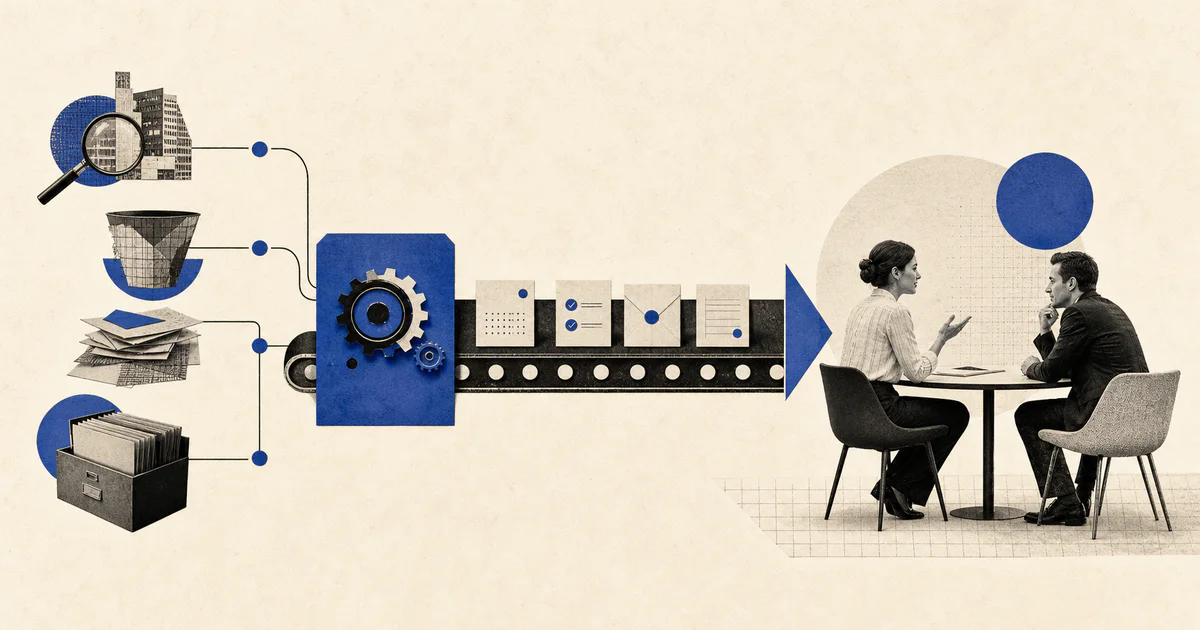
It is an AI workflow system that can:
read messy sales inputs such as forms, emails, call transcripts, and CRM changes
extract the information that matters
classify urgency, intent, and next-step type
enrich account context before a rep touches the record
draft follow-up work
update systems of record
route ambiguous or high-stakes cases to humans
That matters because most sales work is not blocked by a lack of text generation.
It is blocked by fragmented operating context.
The team already has data in the CRM, inbox, call recorder, calendar, and Slack. The problem is that nobody has time to turn that fragmented context into the next clean action every time.
That is where AI helps.
Why this category matters now
B2B teams are under pressure to grow without growing headcount at the same rate.
That makes operational leverage more valuable than another dashboard.
If you have:
inbound demand that goes cold too often
reps doing manual research before every call
inconsistent post-meeting follow-up
sloppy CRM hygiene
slow handoffs between marketing, sales, and success
managers spending pipeline reviews reconstructing what happened
then AI sales automation is worth serious attention.
The point is not to automate "sales" as one thing.
The point is to automate the repeated knowledge work inside sales workflows.
Want an agent doing this for you?
We build custom AI agents and the software around them, shipped in weeks. You own the code, and we stay for support.
If this is the operational drag your team feels most, go deeper on AI CRM automation.
5. Pipeline review and manager prep
Sales managers spend too much time reconstructing deal state from partial notes.
Before a pipeline review, they often need to know:
what changed since the last review
which deals are actually stuck
where rep confidence and evidence do not match
what risks are appearing across the funnel
An AI manager-assist workflow can:
compile deal changes automatically
summarize risk signals
identify missing stakeholder coverage
surface deals with weak next-step discipline
create a structured review brief
That does not replace the manager.
It reduces the amount of manual archaeology required before the manager can make a judgment.
6. RFP and security questionnaire response prep
For teams selling into larger accounts, proposal work creates a different kind of sales drag.
The issue is not only writing. It is retrieving approved answers, coordinating reviewers, and keeping deal-specific responses moving before the deadline. That workflow deserves its own system, which we break down in AI RFP automation.
What not to automate first
Most sales teams get into trouble when they start with the most visible thing instead of the highest-leverage thing.
The most common mistake is over-automating outbound message generation.
Yes, AI can draft cold emails.
No, that does not mean mass autonomous outreach is the best first project.
Be careful about automating:
high-stakes negotiation
pricing conversations
nuanced objection handling
enterprise relationship messaging
anything where a wrong message can damage trust quickly
These are better candidates for assistive workflows than full autonomy.
If you are deciding between deterministic automation tools and a custom agent layer, read AI agents vs. Zapier vs. Make next.
Why most AI sales automation projects disappoint
The failure pattern is consistent.
1. They automate the sentence, not the system
A team sees a strong email draft and assumes the workflow is solved.
It is not.
The hard part is capturing context, routing action, updating the system of record, and handling exceptions.
If those pieces stay manual, the gain is smaller than it looks in a demo.
2. They use one giant agent for everything
One agent reads the lead, does research, scores intent, updates the CRM, drafts the message, and decides what happens next.
That setup is hard to debug and hard to trust.
A better pattern is decomposition:
classify
enrich
score
draft
route
review
Narrow steps are easier to test and easier to improve.
3. They skip human-review design
Selective automation usually works better than full autonomy at the start.
For example:
auto-handle low-risk research prep
suggest CRM updates for approval
escalate high-value or ambiguous opportunities
require review before any sensitive outbound message is sent
That pattern saves time without forcing the team to trust the system blindly.
4. They build without clear sales definitions
If your team does not agree on what counts as:
a qualified lead
a stale opportunity
a strong next step
a real risk signal
then the AI system will reflect that ambiguity.
AI does not fix an undefined sales process. It accelerates whatever process already exists.
The architecture that usually works
For most B2B teams, a useful first version is simpler than the market makes it sound.
You usually need:
An intake layer that receives leads, meeting notes, emails, or CRM events.
A classification step that labels the input and identifies the likely next action.
An enrichment step that pulls the missing context.
A decision layer that returns structured outputs with confidence.
An action layer that updates tools, drafts work, or routes a task.
A human-review path for uncertain or high-stakes cases.
The win is that the team responds faster, loses fewer leads, keeps cleaner pipeline state, and spends more time selling instead of coordinating.
When you should wait
You should probably not prioritize AI sales automation yet if:
your inbound volume is very low
your ICP is changing every week
your CRM is fundamentally broken
your sales process has no clear stages or owners
nobody agrees on what "good follow-up" means
In those cases, fix the operating model first.
Then automate the parts that repeat.
FAQ
What is AI sales automation?
AI sales automation is the use of AI inside sales workflows to classify inputs, enrich account context, draft next steps, update systems, and route work faster. In practice, it works best as workflow infrastructure, not as a fully autonomous replacement for sales reps.
What sales tasks should companies automate first with AI?
Most companies should start with inbound qualification, account research, post-call follow-up, CRM hygiene, and manager prep. Those workflows are frequent, repetitive, and closely tied to pipeline speed. If account prep is the main bottleneck, see our detailed guide to AI account research automation.
Can AI replace SDRs or account executives?
For most B2B teams, no. AI is better at supporting repeated coordination work than replacing relationship-driven selling. The strongest early use cases are assistive systems with human review, not full sales autonomy.
How do you know if AI sales automation is working?
Track operational metrics first: response time, routing accuracy, CRM completeness, follow-up speed, stale-opportunity rate, and acceptance rate on AI-generated drafts. Those numbers tell you whether the workflow is actually improving.
Where V12 Labs fits
V12 Labs builds production AI workflow systems for revenue and customer teams.
That usually means identifying one expensive manual workflow, mapping the real operating path, then building the AI system around clear steps, review points, and integrations.
If your sales team is buried in inbound triage, post-call admin, pipeline cleanup, or fragmented follow-up, start with our AI workflow systems offering.