2026-04-12ai-agentstechnical-architecturemvp-development

Building AI Agent Teams That Actually Ship

V12 Labs5 min read
Building AI Agent Teams That Actually Ship - Featured image

Short answer

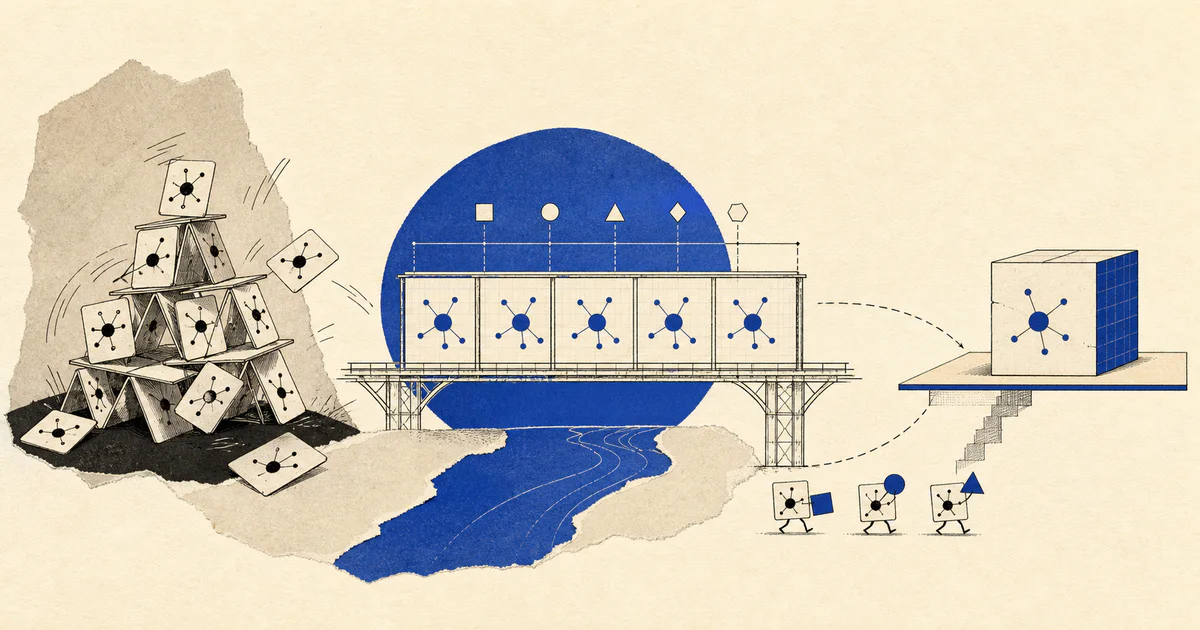
Most AI agent setups look impressive in demos and collapse in production. Here's how V12 Labs structures multi-agent systems that reliably deliver, from architecture decisions to failure recovery.

There's a moment every founder using AI agents knows well: the demo works perfectly, you show the team, everyone's excited, and then it silently breaks in production for three days before anyone notices.

We've built and operated multi-agent systems at V12 Labs long enough to know what separates agent setups that ship from ones that just look like they ship. This post is the honest version.

If you would rather have V12 Labs build it, get your free build plan. We will put the scope, timeline, and price range in writing. You keep the plan, and if we build it, you own the code, data, and IP from day one.

On this page

The Core Problem: Agents Are Optimists

Large language models, at their core, are trained to produce plausible-sounding output. That's great for generating content. It's a liability in production systems where "I'll start executing this now" in a task summary does not mean the thing actually executed.

The failure mode is subtle: an agent reports completion, the system marks the task done, and nobody checks the actual artifact, the GitHub commit, the sent email, the API call log.

We call this summary-completion drift, where the agent's summary of what it did diverges from what actually happened.

Architecture Principle 1: Verify Outputs, Not Summaries

Every agent output that matters should have a verifiable artifact:

  • Blog posts: Check the actual GitHub commit SHA, not the agent's report
  • Emails: Check delivery receipts or sent folder, not "I sent the email"
  • API calls: Log the HTTP response status, not the agent's interpretation
  • Database writes: Query the record, don't trust the agent's confirmation

This sounds obvious. Most teams skip it because the demos never fail. Production always finds the edge case.

In practice, we build a lightweight "artifact verifier" layer that runs after agent task completion. It's not another AI, it's deterministic code that checks the actual state of the world.

Want this built for your business?

We build custom software and AI agents that ship in weeks. You own the code, we stay for support.

Get your free build plan

Free. 30 minutes. You leave with scope, timeline, and a price range.

Architecture Principle 2: Design for Partial Failure

A multi-agent system where any single agent failure halts the whole pipeline is a liability at scale. Production systems need graceful degradation.

The pattern we use:

Task → Agent Attempt → Artifact Check → 
  [Success] → Continue
  [Failure] → Retry with context → 
    [Success] → Continue
    [Failure] → Escalate to human → Flag for review

The key insight: escalation is a feature, not a failure. An agent that says "I tried twice and it didn't work, here's what happened" is more valuable than one that silently retries indefinitely or falsely reports success.

We build explicit "escalation paths" into every agent workflow. If an agent can't complete a task within N attempts or M minutes, it surfaces to a human review queue with full context.

Architecture Principle 3: Specialization Over Generalism

Early in building agent systems, the temptation is to use one powerful agent for everything. It's simpler. It works in demos.

In production, specialized agents consistently outperform generalist ones on bounded tasks. Here's why:

  1. Context window efficiency: A specialized agent's system prompt is tailored to its domain, it doesn't waste context on irrelevant instructions
  2. Failure isolation: When a specialized agent fails, the failure mode is predictable and recoverable
  3. Iteration speed: You can improve a content agent without touching your outreach agent

The downside of specialization is coordination overhead. You need an orchestration layer, something that routes tasks, tracks state, and handles handoffs. This is non-trivial to build, but the investment pays off fast once you're running more than 3-4 concurrent agent types.

The State Problem

The hardest part of multi-agent systems isn't the agents, it's state.

Agents are stateless by default. Every session starts fresh. This means any state that needs to persist across agent runs must be:

  1. Written to durable storage (database, file system, external API)
  2. Surfaced in context when the agent next runs
  3. Versioned so conflicts can be detected

Teams that skip this end up with agents that "forget" what they've already done, creating duplicates, sending repeated emails, or overwriting each other's work.

We use a simple pattern: every agent task has a checkpoint_json field that stores the last known good state. On restart, the agent loads this state and resumes, rather than starting over.

When to Use Humans in the Loop

The question isn't whether to include human review, it's where to put it.

Human-in-the-loop is most valuable at:

  • High-stakes external actions: Sending emails, publishing content, making payments
  • Ambiguous decisions: Where the agent's confidence is low
  • Novel situations: First time a new type of task runs in production
  • Cost thresholds: Before executing anything that costs meaningful money

Human review becomes a bottleneck when it's applied to everything. The goal is to automate the confidence-building over time: start with human review on everything, instrument which approvals are always rubber-stamped, and gradually automate those paths.

What "Production-Ready" Actually Means for AI Agents

Here's our working definition:

  1. Artifacts are verifiable, every meaningful output can be confirmed independent of agent self-report
  2. Failures escalate cleanly, no silent failures; every error surfaces with enough context to debug
  3. State is durable, agents can restart mid-task without losing progress or causing duplicates
  4. Humans are in the right loops, not too many, not too few, placed at genuine decision points
  5. Costs are bounded, runaway agent loops don't drain your API budget overnight

Most agent systems check 2 or 3 of these. Systems that check all 5 are genuinely production-ready.

The V12 Labs Approach

We've been building and running multi-agent systems for our own operations and for clients long enough to have opinions about what works. The short version:

  • Start with a narrow, high-value workflow (not "AI for everything")
  • Instrument it heavily before you trust it
  • Build the human escalation path before you need it
  • Verify artifacts deterministically, not through agent self-report
  • Expand scope only after the narrow case is stable

The AI agent space moves fast, but the fundamentals of reliable software engineering don't change. The teams shipping real value from agents are the ones treating them like software systems, with all the rigor that implies.


Not sure what to build, buy, or skip? Get your free build plan. We will put the recommended scope, timeline, and price range in writing, and you keep it either way.

If V12 Labs builds it, you own the code, data, and IP from day one.
Where this fits

Get a clear plan before you spend.

V12 Labs will put the scope, timeline, and price range in writing. If we build it, you own the code, data, and IP from day one.

Related reading

Anthropic Just Released the Claude Agent SDK. Here's What It Actually Means

Anthropic shipped the Claude Agent SDK alongside Sonnet 4.5, the same infrastructure that powers Claude Code, now available to every developer. Here's what's in it, what it can do, and why it matters for founders building AI products.

Managed AI Agents in 2026: What Claude and OpenAI Actually Built

Claude's Model Context Protocol and extended thinking vs OpenAI's Agents SDK and Responses API, a practical breakdown of what both platforms now offer for building production agent systems, and what it means for founders.

Production AI Agent Architecture: Lessons From Building CrewKit

Why most multi-agent systems break in production, and the architecture we built instead. The Mind, the durable primitives, the learning loop, and the anti-patterns we ran into the hard way.

Bland.ai + Twilio Integration: How We Built Production AI Phone Agents

How Bland.ai and Twilio work together for production AI phone agents, where ElevenLabs-style voice stacks fit, and what teams still need to build.

Loop Engineering, Explained: What It Is, What's Overhyped, and Where It's Going

Loop engineering went from an unknown phrase to the AI industry's biggest buzzword in about a week. Here's what it actually means, where the backlash has a point, and where the practice goes from here.

Stop Botsitting AI Agents: Build AI Workflow Systems Instead

Botsitting AI agents creates hidden supervision work. Revenue teams need AI workflow systems with context, integrations, approvals, monitoring, and clear ownership.

Get a build plan