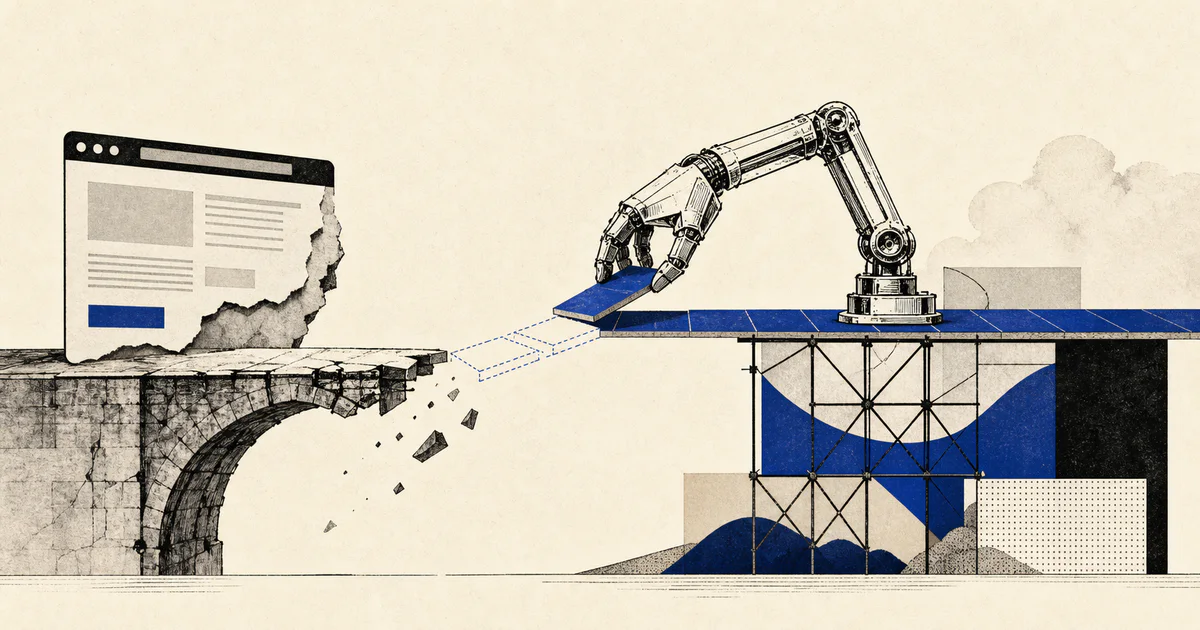
Browserbase Stagehand: A Smarter Way to Build Browser AI Agents
V12 Labs··9 min read
Short answer
Most AI agents break at the browser layer. Here's why Browserbase Stagehand is one of the more interesting products for building resilient web agents in production.
If you're building AI agents that need to do real work on the web, the browser layer becomes the problem faster than the model layer.
The model can reason. The prompt can be good. The workflow can look elegant in a demo. Then the agent hits a login wall, a slightly changed button label, a brittle selector, or a multi-step UI with no API behind it, and the entire system starts behaving like a fragile intern.
That is why products like Browserbase Stagehand are worth paying attention to.
Stagehand is not another generic "AI agent platform." It is a more focused product: a browser automation framework designed for agents that need to interact with websites in a way that survives real-world UI drift. For teams building sales ops automations, support workflows, onboarding systems, procurement assistants, research agents, or internal back-office automations, that matters a lot.
At V12 Labs, we spend most of our time thinking about production AI workflow systems, not agent demos. So when we look at a product like Stagehand, the question is not "is this cool?" The question is: does this remove a real production bottleneck?
In this case, the answer is yes.
If you would rather have V12 Labs build it, get your free agent plan. We will put the scope, timeline, and price range in writing. You keep the plan, and if we build it, you own the code, data, and IP from day one.
Stagehand is an open-source browser automation framework from Browserbase. Its core promise is simple:
let developers control browser workflows with natural-language instructions without giving up structure or reliability.
Instead of hardcoding every interaction through brittle selectors, Stagehand gives you a small set of primitives:
act() for taking actions on a page
extract() for pulling structured data out of a page
observe() for understanding what on the page is currently actionable
agent() for longer multi-step browser workflows
That design choice is what makes it interesting.
Most teams trying to build browser agents fall into one of two bad options:
They use raw Playwright or Selenium and end up maintaining a graveyard of broken selectors.
They hand everything over to a black-box agent and lose control, predictability, and debuggability.
Stagehand sits in the middle. You still define the flow. You still control where precision matters. But you get a layer of AI-assisted resilience when the page changes or the browser needs to interpret a more human instruction.
That middle ground is where a lot of real agent systems should be built.
Why This Product Matters More Than It Looks
There are plenty of AI products that get more hype because they sound more autonomous. Stagehand is more useful because it solves a narrower, uglier, more common problem.
The problem is this:
most business software still requires browser interaction, and a shocking amount of valuable work still lives in tools with weak APIs, partial APIs, or no API at all.
If you want an agent to:
pull leads from a partner portal
update fields inside a vendor dashboard
gather documents from a customer onboarding flow
reconcile data across two web apps
file a claim, submit a form, or trigger a follow-up in an internal tool
then your agent usually needs a browser, not just an LLM.
This is where many "AI agent" discussions become unserious. People talk about planning, memory, and tool use at a very abstract level while ignoring the part where an actual business process depends on clicking through ugly interfaces built in 2019.
That is also why browser infrastructure is becoming a serious category inside the agent stack.
Want an agent doing this for you?
We build custom AI agents and the software around them, shipped in weeks. You own the code, and we stay for support.
The best use cases are not flashy consumer agents. They are operational workflows where humans already spend hours inside repetitive browser loops.
Here are the kinds of systems where a product like Stagehand becomes genuinely valuable.
1. Lead Qualification Across Messy Web Systems
Imagine a revenue team receiving inbound leads from multiple sources:
website forms
partner directories
event lead exports
niche marketplaces
Some of that data lands cleanly in the CRM. Some does not. Some requires checking enrichment tools, reviewing company websites, and updating fields in portals that were never designed for automation.
A production AI workflow can use Stagehand to navigate those environments, extract the right context, and complete structured actions without forcing the team to build custom API integrations for every system.
That is the right kind of leverage. Not "replace the whole team." Just remove the manual browser work that should never have needed a human in the first place.
2. Customer Support and Operations Workflows
Support teams often live inside multiple browser tabs:
helpdesk
internal admin panel
billing tool
shipping portal
documentation system
An agent that can read a ticket, decide what information it needs, inspect the right systems, and draft or complete the next action is only as good as its ability to operate across those tools.
If every browser action breaks when a UI changes, the agent never becomes production-safe. A resilient browser layer is the difference between a demo and an operational system.
3. Customer Onboarding Systems
Many onboarding flows still involve manual status checks, form completion, data verification, and follow-ups across external tools. These are ideal agent workflows because the work is repetitive, rules-based, and spread across interfaces.
This is exactly the kind of workload V12 Labs calls manual knowledge work inside an inbound workload. It is not glamorous work. It is just expensive work. And it is often trapped inside the browser.
4. Internal Agent Tools for Small Teams
Early-stage companies often cannot justify deep integrations into every tool they use. Browser automation becomes the fastest path to shipping value.
That makes Stagehand especially interesting for founders and operators who want a working internal agent this quarter, not a six-month platform initiative.
The Architecture Lesson: Don’t Let the Browser Agent Run the Whole System
This is the part many teams get wrong.
A browser automation framework is not the system. It is one component inside the system.
If you hand the entire workflow over to a browser agent, you create a fragile, expensive black box. The better pattern is:
use a durable workflow layer to track jobs, retries, approvals, and outcomes
use an LLM layer for reasoning, classification, and decision support
use a browser execution layer like Stagehand only where the workflow needs web interaction
keep critical business state outside the browser session
In other words, the browser agent should execute work. It should not become your source of truth.
This matters because browser sessions fail. Pages change. Authentication expires. Captchas appear. Human review is still needed for risky actions. If your system architecture assumes perfect browser autonomy, it will fail the first time a real customer depends on it.
The teams that win with agents in production are the teams that separate:
reasoning
execution
memory
policy
audit trail
Stagehand helps with the execution layer. It does not remove the need for the rest.
That is a good thing. Narrow products often create more value than broad promises.
What Makes Stagehand Better Than Raw Browser Scripting
The strongest argument for Stagehand is not that it is "AI-powered." That phrase is too cheap now.
The stronger argument is that it gives you a more maintainable abstraction for browser work.
With raw scripting, your team ends up encoding a huge amount of page structure into selectors and DOM assumptions. Every redesign becomes maintenance work. Every failure becomes a debugging session.
With Stagehand, you can express intent at a higher level while keeping explicit control over the workflow. That is a better fit for agent systems because intent tends to remain stable longer than markup.
The page might change from one button class to another. The business action usually does not change. "Open the account record." "Download the invoice." "Submit the claim." "Extract the vendor name and renewal date." Those are stable operational intents.
Good agent infrastructure preserves that level of abstraction as long as possible.
The Real Risks and Limitations
No serious AI product discussion is complete without this section.
Stagehand is useful, but it does not magically solve browser automation.
You still need to think about:
authentication and session handling
anti-bot protections
compliance and access controls
fallback behavior when page understanding is ambiguous
human approval for high-risk actions
observability when an execution path goes sideways
And you should still be selective about where browser automation belongs. If a stable API exists, use the API first. Browser action should be the right tool for the right job, not your default integration strategy.
We would also avoid putting fully autonomous browser execution in front of customer-facing actions with no review loop unless the scope is extremely narrow and well-tested.
The right production question is not "can the agent do this?" It is "can the agent do this repeatedly, safely, and with acceptable failure handling?"
Who Should Pay Attention to Stagehand
This product is worth watching if you are:
building AI agents that need to work across real web apps
trying to automate an internal workflow where APIs are incomplete
shipping ops automations for sales, support, onboarding, or finance
looking for a middle ground between brittle scripts and black-box autonomy
It is especially relevant if your workflow bottleneck is not model quality but execution reliability.
That is a far more common problem than most founders realize.
Why This Matters for the Next Wave of AI Products
A lot of the next useful AI companies will not be won by whoever has the flashiest general-purpose agent. They will be won by teams that solve the ugly layers between reasoning and execution.
Browser interaction is one of those layers.
Products like Stagehand matter because they make it more realistic to turn AI from a draft generator into an operator inside a live workflow. Not by pretending the hard parts disappeared, but by making one of the hardest parts more manageable.
That is usually how real categories are built.
If you're a founder or operator exploring AI agents, this is the right mental model: stop asking whether the model is smart enough in isolation. Start asking whether the full system can reliably observe, decide, act, recover, and be reviewed.
That is the difference between an AI experiment and an AI workflow system.
At V12 Labs, that is the line we care about most. We build AI workflow systems for teams buried in manual knowledge work, especially where the work moves through messy tools, approvals, and browser-heavy operating flows.
If you're trying to turn one painful browser-based process into a production AI system, start a conversation with us.